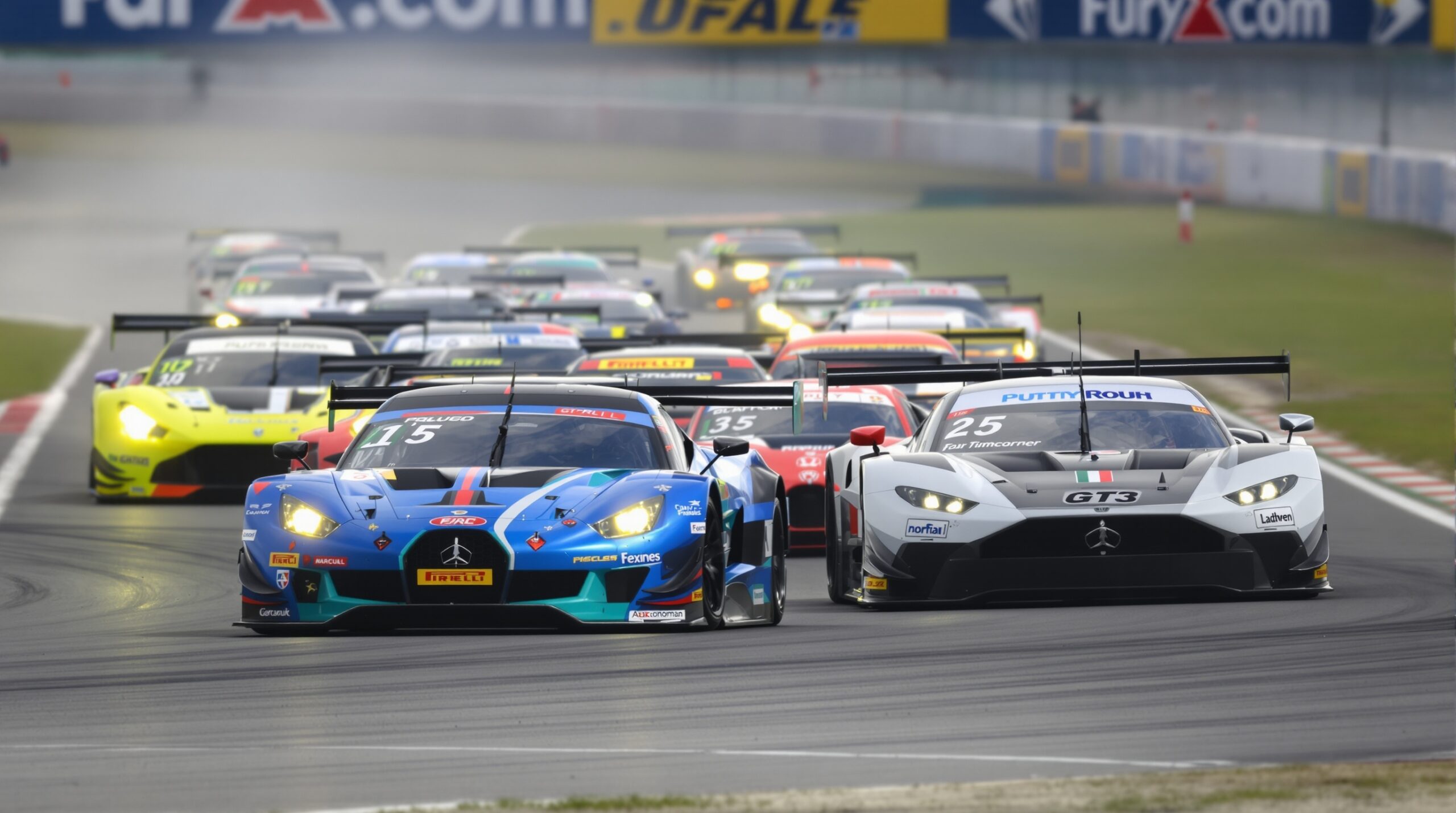
GT3 racing is designed to keep competition close. One of the key elements that ensures this balance is aerodynamic regulation combined with Balance of Performance.
Unlike prototype racing, where teams push the limits of engineering with little restriction, GT3 is built around a philosophy of controlled performance. Manufacturers are allowed to develop visually aggressive and technically advanced cars, but within a framework that prevents any one design from dominating. Aerodynamics sits at the center of this balance, shaping how cars behave on track while being tightly monitored by governing bodies.
The Philosophy Behind GT3 Aerodynamics
GT3 cars are derived from production-based models, but their aerodynamic packages are far more advanced than anything found on the road. Large rear wings, front splitters, dive planes, and diffusers all contribute to increased downforce and stability.
However, unlike in unrestricted racing categories, these components are not designed purely for maximum performance. Instead, they are engineered within strict limits. The goal is not to create the fastest car possible, but to ensure that different cars — front-engine, mid-engine, naturally aspirated, turbocharged — can compete on equal footing.
This philosophy means that aerodynamics in GT3 is as much about regulation as it is about engineering.
Homologation: Locking the Design
One of the defining features of GT3 racing is homologation. When a manufacturer introduces a new car, its aerodynamic package is approved as a fixed specification. This includes the shape and size of the wing, splitter dimensions, and bodywork elements.
Once homologated, teams cannot freely modify these components. Unlike other categories where upgrades happen throughout the season, GT3 cars remain largely unchanged. This prevents wealthier teams from out-developing smaller competitors and keeps the grid competitive over time.
Homologation also ensures that each car retains its identity. A Ferrari will still behave differently from a Porsche or an Aston Martin, even if their lap times are closely matched.
Balance of Performance: The Equalizer
Even with strict aerodynamic rules, inherent differences between cars remain. A mid-engine car might generate more efficient downforce, while a front-engine car could offer better stability under braking.
This is where Balance of Performance, or BoP, comes into play.
BoP adjustments are used to equalize performance across the grid. These can include changes to weight, engine power, ride height, and sometimes aerodynamic parameters. While the visible aero components remain the same, their effectiveness can be influenced indirectly through these adjustments.
For example, increasing ride height can reduce diffuser efficiency, effectively lowering downforce without changing the actual bodywork. Similarly, weight distribution changes can alter how a car utilizes its aerodynamic grip.
The result is a constantly evolving balance that keeps racing tight and unpredictable.
Wind Tunnel Testing and Data Analysis
Behind the scenes, GT3 regulation relies heavily on data. Governing bodies work with manufacturers to evaluate aerodynamic performance using wind tunnels and computational simulations.
Each car is analyzed to determine its drag, downforce levels, and aerodynamic efficiency. This data becomes the foundation for BoP decisions. Race results, telemetry, and even weather conditions are also taken into account.
Modern GT3 racing is not just about what happens on track — it is about how accurately performance can be measured and adjusted off it.
Managing Dirty Air and Close Racing
Aerodynamics plays a crucial role in how cars interact with each other on track. In many racing categories, following another car closely leads to a loss of downforce due to turbulent air, making overtaking difficult.
GT3 regulations aim to minimize this effect.
While dirty air still exists, the cars are designed to be less sensitive to it compared to high-downforce prototypes. This allows drivers to stay closer through corners and increases the chances of overtaking on straights and braking zones.
It is one of the reasons why GT3 racing is known for close battles and frequent position changes.
Manufacturer Diversity and Aero Compromise
One of the most fascinating aspects of GT3 racing is the variety of car designs. From the rear-engine layout of the Porsche 911 to the front-engine configuration of the Mercedes-AMG GT3, each platform brings unique aerodynamic challenges.
Regulations must accommodate all these designs without favoring one over another.
This often leads to compromises. A car that excels in high-speed corners might be slightly restricted to prevent dominance, while another that struggles with drag may receive adjustments to remain competitive.
The result is a grid where no single concept is universally superior, and success depends on track conditions, setup, and driver skill.
Track-Specific Performance and Aero Setup
Although the aerodynamic components are fixed, teams still have some flexibility in setup. Wing angles, ride height, and suspension settings can all influence how the car performs aerodynamically.
Different tracks place different demands on the cars. High-speed circuits like Monza require low drag and minimal wing angles, while technical tracks like Brands Hatch reward higher downforce.
Teams must find the optimal balance within the limits of the regulations, making setup work a critical part of GT3 racing strategy.
The Future of GT3 Aerodynamics
As motorsport evolves, GT3 continues to adapt. New technologies, such as improved simulation tools and hybrid systems, are influencing how cars are designed and regulated.
There is also increasing focus on sustainability and cost control. Future regulations may further standardize certain components to reduce development costs while maintaining competitive balance.
At the same time, the core philosophy of GT3 is unlikely to change. Close racing, manufacturer diversity, and controlled performance will remain at the heart of the category.
Conclusion
GT3 racing represents a unique approach to motorsport. Instead of chasing absolute performance, it focuses on creating a level playing field where different cars can compete fairly.
Aerodynamic regulation, combined with Balance of Performance, ensures that no single design has a lasting advantage. It transforms what could be an engineering arms race into a carefully managed competition where the outcome is never guaranteed.
In the end, the real winners are the fans, who get to watch some of the closest and most exciting racing in the world — where every lap is shaped not just by speed, but by the delicate balance of aerodynamics and regulation.