
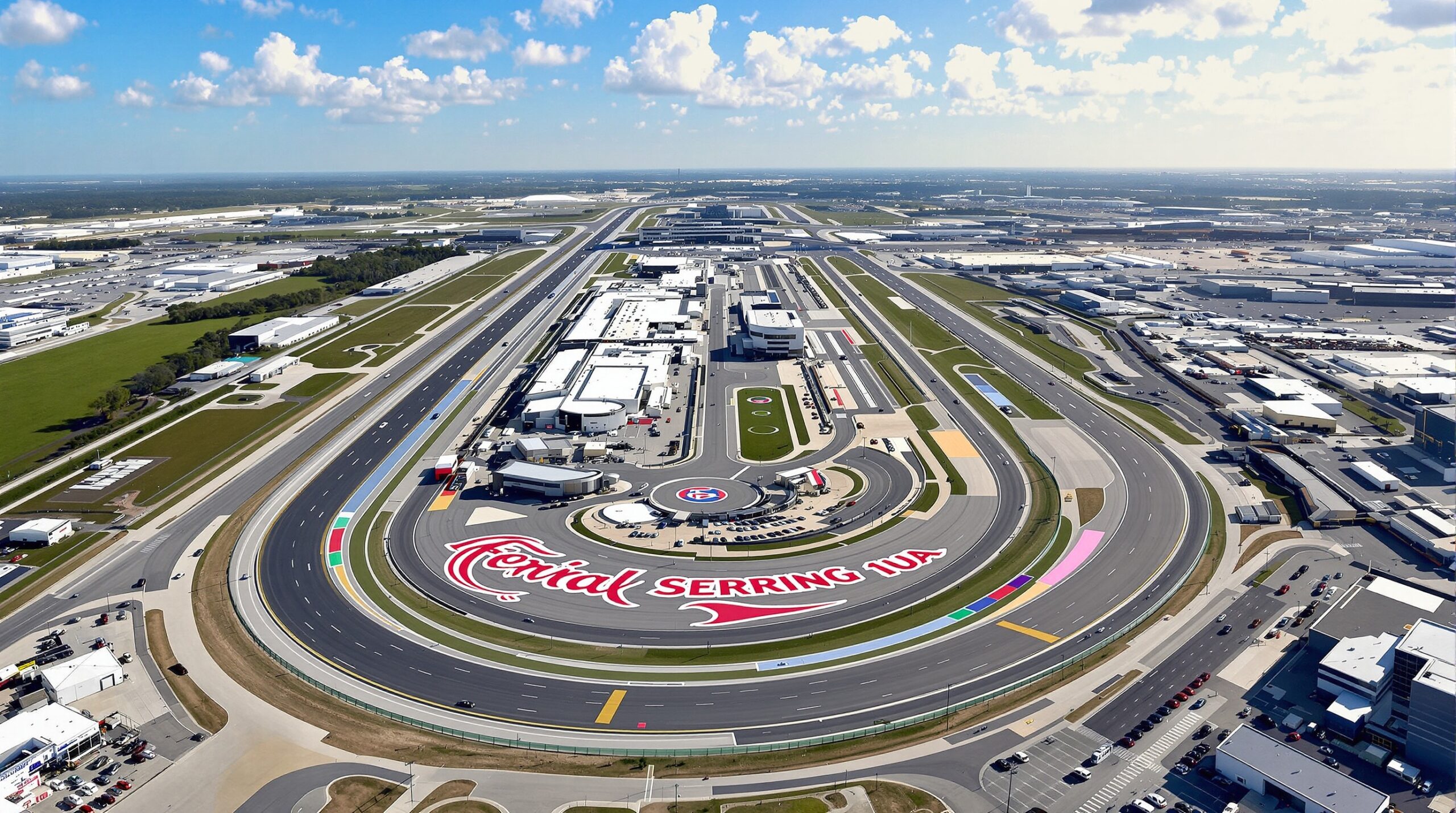
Sebring International Raceway is known as one of the toughest circuits in the world. Built on a former airfield, its concrete surface creates extreme conditions for both cars and drivers. Unlike modern tracks with smooth asphalt and forgiving layouts, Sebring remains raw, unpredictable, and relentlessly demanding.
A Track Born from Aviation
Sebring’s origins date back to World War II when Hendricks Field served as a training base for B-17 bomber crews. After the war, the expansive runways and service roads were repurposed into a racing circuit. What makes Sebring unique is that much of its layout still uses the original concrete slabs from the airfield.
These slabs were never designed for racing. They were built for durability under heavy aircraft, not for grip or consistency. As a result, the track surface is uneven, bumpy, and constantly shifting under load. This gives Sebring its infamous character — a circuit that tests not just speed, but resilience.
The Brutal Surface
The defining feature of Sebring is its surface. Unlike traditional racetracks, which are resurfaced regularly, Sebring retains its aging concrete in many sections. The seams between slabs create violent vibrations that can unsettle even the most advanced race cars.
Drivers often describe Sebring as a “war zone” for suspension systems. Every lap delivers repeated shocks that can lead to mechanical failures if a car is not properly prepared. Teams must carefully balance performance and durability, often sacrificing outright speed to ensure the car survives.
Tires also suffer immensely. The abrasive nature of the concrete wears rubber quickly, forcing teams to rethink strategy and pit stop timing. In endurance racing, where every second counts, this adds another layer of complexity.
A Test of Driver Endurance
Sebring does not just challenge machines — it pushes drivers to their limits as well. The constant bumps and vibrations create physical strain over long stints. Arms, neck, and core muscles are under continuous stress, especially during the famous 12-hour race.
Visibility can also become an issue. As the race transitions from day to night, drivers must adapt to changing light conditions while navigating a track that offers little margin for error. The combination of fatigue, darkness, and traffic makes Sebring one of the most mentally demanding circuits in motorsport.
Precision is critical. A small mistake can lead to significant consequences, especially in sections where the concrete meets asphalt, creating unpredictable grip levels.
The 12 Hours of Sebring
The crown jewel of the circuit is the 12 Hours of Sebring, one of the oldest endurance races in the United States. First held in 1952, it quickly became a cornerstone of global sports car racing.
Unlike sprint races, endurance events at Sebring require a completely different approach. Success depends on consistency, reliability, and teamwork. Drivers rotate in and out of the car, engineers monitor every system, and pit crews execute flawless stops under pressure.
Sebring’s unique challenges make it a true proving ground. Winning here is not just about speed — it is about surviving one of the harshest environments in racing.
Over the decades, the race has attracted the biggest names in motorsport, from legendary manufacturers to world-class drivers. Victories at Sebring are often seen as a badge of honor.
Engineering for Survival
Preparing a car for Sebring requires a different mindset compared to other circuits. Engineers must reinforce suspension components, optimize cooling systems, and ensure that every part can withstand hours of punishment.
Ride height is often adjusted to handle the uneven surface, even if it compromises aerodynamic performance. Brake systems must be robust enough to endure repeated heavy use without failure. Every decision is a trade-off between speed and durability.
Teams that underestimate Sebring often pay the price. Mechanical failures are common, and even the smallest weakness can end a race prematurely.
Changing Conditions
Another factor that makes Sebring so demanding is its variability. The track evolves throughout the race as temperatures change and rubber builds up on the surface. Grip levels can fluctuate dramatically between sessions.
Weather also plays a role. Florida’s climate can introduce sudden rain showers or intense heat, both of which add to the challenge. Drivers must constantly adapt their approach to maintain control.
Nightfall brings a completely different atmosphere. The track becomes darker, cooler, and more unpredictable. Headlights illuminate only a narrow path, making navigation even more difficult.
A Legacy of Toughness
Sebring has earned its reputation over decades of relentless racing. It is not a circuit that flatters drivers or cars. Instead, it exposes weaknesses and rewards those who can endure.
Many modern tracks are designed with safety and comfort in mind. Sebring, by contrast, remains a raw test of skill and engineering. It represents a different era of motorsport — one where resilience mattered as much as speed.
For fans, this is part of its appeal. Sebring delivers drama, unpredictability, and a genuine sense of challenge that is increasingly rare in modern racing.
Why Sebring Still Matters
In an era of high-tech circuits and controlled environments, Sebring stands out as a reminder of what makes motorsport compelling. It is a place where tradition meets innovation, where modern machines must confront old-school conditions.
Manufacturers use Sebring as a benchmark. If a car can survive here, it can perform anywhere. This makes the circuit an essential stop on the calendar for teams looking to prove their capabilities.
For drivers, mastering Sebring is a milestone. It demands precision, endurance, and mental strength — qualities that define the best in the sport.
Conclusion
Sebring International Raceway is more than just a track. It is a test of limits, a battlefield where machines and drivers are pushed to the edge. Its rough surface, demanding layout, and unpredictable conditions make it one of the most punishing circuits in America.
Yet, it is precisely these challenges that give Sebring its legendary status. In a sport driven by speed and technology, it remains a place where toughness still matters.